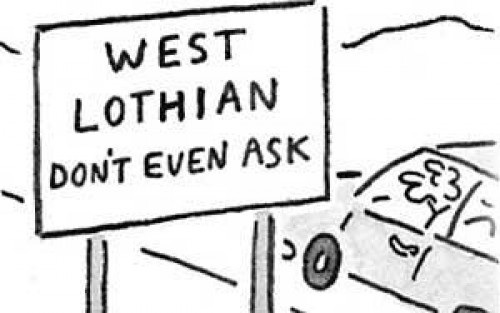
You’re probably all familiar with the term ‘West Lothian Question’. It was first coined in 1977 by Enoch Powell in response to Tam Dayell repeatedly raising the point that a legislative Scottish assembly would create the unacceptable situation in which English Members at Westminster would be prevented from voting on Scottish health, education and other devolved matters while Scottish MPs could vote on health and education in England but, ludicrously, not on those same matters as they pertain to their own constituencies.
That unacceptable situation, that affront to democracy, has been a much resented reality for the English since 1998, mitigated only slightly by the English Votes on English Laws interregnum during which Scottish, Welsh and Northern Irish MPs still voted on England-only legislation, but just not at every reading.
The House of Lords (the Upper House), has its own version of the West Lothian Question. Those who sit in the House of Lords, though they do not represent a constituency, are nevertheless appointed from across the United Kingdom. This means that Scottish, Welsh and Northern Irish peers scrutinise and make amendments to England-only legislation originating in the Commons (the Lower House), while there is no such Lords’ scrutiny and amending of legislation that originates at Holyrood, the Senned or Stormont because they are unicameral parliaments.
This ‘Upper West Lothian Question’ has never proved as divissive as the original WLQ but that could change if the House of Lords is abolished in favour of an elected upper house.
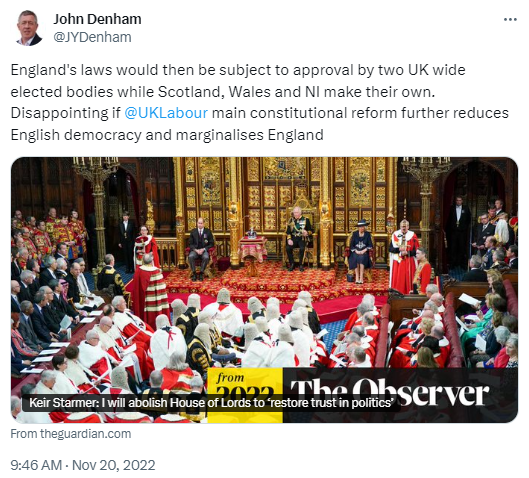
It has been suggested, by those with an interest in Labour’s proposals, that the Scots, Welsh and Northern Irish should be over-represented, so that their ability to influence England-only legislation is greater than it is in the Commons.
In the context of the UK—given the dominance of a single nation—a strong overweighing of Scottish, Welsh, and Northern Irish representation (without necessarily making their representation equal to that of England) would be essential. Many second chambers that were designed to play the role of a chamber for regions have failed in this task because of strong party discipline (such as in Brazil). The UK, however, has witnessed an increasingly federal party system, with the rise of nation-specific parties in Scotland, Wales and Northern Ireland. Given this reality, the prospects of a second chamber doubling up as a chamber for the regions and nations are not hopeless.
This is the prospect that potentially awaits England. Denied its own parliament, government and first minister to initiate its own legislation, and then having its UK-drafted legislation amended and sent back by a second chamber rigged against England. All in an environment designed to encourage English regionalism and, presumably, regional English parties in a ‘federal party system’. Conveniently, the Labour Party is already set up with regional proto-parties (See, for example, ‘Labour East‘).

 English Commonwealth
One thought on “The Upper West Lothian Question”