Over the past few days there’s been a dawning realisation that Labour’s plans for English devolution might be an attack on local democracy. The Times warned us that ministers are drawing up plans to promise more powers for England’s county councils in exchange for the abolition of district councils. According to the Times, district councils are seen as blockers of growth by regularly rejecting housing developments. The ‘nimby blockers’ that Angela Rayner has set her sights on is actually English local government. Commenting on Keir Starmer’s plans to ‘push through reforms to Britain’s [sic] “ruinous” planning system’, another Times article informed us that ministers plan to bypass planning committees and that under their ‘preferred model, mayors would be handed powers to call in “significant” planning applications and take over responsibility for approving or rejecting them’. The BBC ran an article informing us that all 15 of Lancashire’s council could be scrapped, potentially weaking female representation in politics.
Simon Lee, writing on X, was scathing over the manner in which Labour was trying to implement this:
Delegation to executive mayors,without democratic legitimacy of a prior approval referendum, is a substitute for fair funding, and genuine political autonomy over policy design and resource allocation for English local government. This is sham #devolution.
– Simon Lee
Mary Beard, writing on Bluesky was also concerned.
My problem is that I trust big developers less than I trust local planning committees ! Angela Rayner wants to strip councils of power to veto developments. – Mary Beard
This is not the devolution offered to Scotland and Wales. Where is England’s national conversation about how we wish to be governed as a nation? Why is English devolution an elite-to-elite transaction: funding in exchange for ‘Rebuilding Britain’? Where is our referendum?
As Matthew Parris observed, ‘North of the border, the word “devolve” means giving a nation new powers. South of the border it means taking a nation’s powers away.’
Today, Simon Jenkins laid into Labour’s regional agenda in the Guardian:
Planning has become a battleground, largely resolved by inspectors and judges on a site-by-site basis. Rayner wants to replace this through so-called regional mayors. This is a contradiction in terms. Britons identify mayors with towns and cities. Ministers including John Prescott tried to regionalise England and failed. Today “regional” is merely code for central direction.
In truth, this Labour government wants to take control of the land of England, much as its predecessors centralised control of its health and education. In doing so it will complete the centre’s grasp of power over the local, a grasp that has patently not worked. It will not “cure” any crisis. It is anti-democratic – and will do little more than aid Reform.
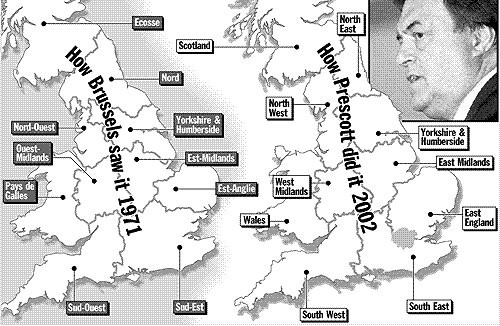
It was ever thus. One of the main objections to Prescott’s regional assemblies (other than being ahistorical, coinciding with the Europe of the regions model and balkanising England) was that they took power away from localities rather than devolving power from Westminster. The fight against Prescott’s regionalism brought together local democracy campaigners, campaigners for historic counties, English parliament campaigners and anti-EU campaigners. As a director of the Campaign for an English Parliament at the time, I remember the fight against regional assemblies as something of a high-point for the campaign. We attracted many new supporters. In Prescott we had a pantomime villain riding rough-shod over local democracy, without a care for English nationhood or national sensibilities, seemingly at the bidding of the EU (if you believed the Tory press – info graphic from the Telegraph circa 2002).
Prescott was deservedly thrashed. Writing after the referendum, the Guardian’s Peter Hetherington noted:
‘the romantic stirrings of Yes 4 the North East failed to resonate among a population that is probably more ‘English’ – rather than British, with vague notions of Englishness – than many realise. One of the authors was struck by the number of times respondents in straw polls raised worries about the impact a partly-devolved North East would have on the unity of England, and the implications for other regions.’ (UCL: Devolution Monitoring Programme, November 2004)
The fight against the North East regional assembly was where Dominic Cummings cut his political teeth. It was also a fillip for UKIP and Nigel Farage. In 2003, Farage came to speak to the Campaign for an English Parliament’s Future of England Conference, along with Neil Herron (Director of North-East Against a Regional Assembly) and Simon Hughes (Liberal Democrats). It might surprise some to know, given that Farage has frequently been described as an English nationalist, that of those three speakers it was Farage who was opposed to an English parliament.
But my point is this. Nigel Farage recognised the need to mobilise English opinion and whip up English anxieties over how their nation was being divided up. Simon Jenkins is correct to warn that Farage’s new vehicle, Reform UK, could do this again if Labour strip away England’s democratic control over planning.

 English Commonwealth