European Movement UK recently did a webinar featuring Caroline Lucas and John Denham on the Role of National Identity in the Journey Back to Europe. It’s well worth a watch.
In the Q&As there’s a quite extraordinary question from a listener:
Why can’t the English realise that their national / regional identity is far more protected within the European Union than within the UK?
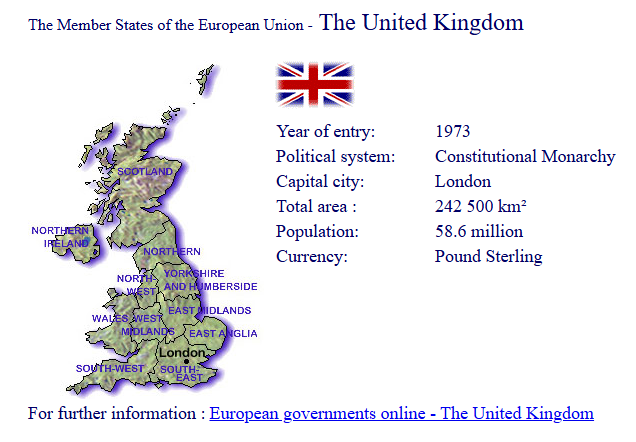
It’s hard to know where to begin or to even understand what the questioner was getting at. What protection of English national identity does he think either the UK or the EU offer? For many years, this map of the UK (which doesn’t mention England but does mention Scotland, Wales and NI) was on the EU’s website. It was frequently circulated by anti-EU groups as evidence that England was being regionalised out of existence by EU federalists.
EU federalists themselves gave some credence to this by goading the English. Some took pleasure in English anxiety. Charles Kennedy, for instance, one of the signatories to the Scottish Claim of Right, argued against an English parliament while proposing a regional, EU solution and mocking English turmoil over their identity.
Do I detect a certain schadenfreude among Scots at the apparent current turmoil among the English over their sense of national identity? If so, it is given extra savour because that crisis of identity is provoked at least in part by the creation of the Parliament in Scotland and the Assembly in Wales. Suddenly it is Scotland which is forging ahead in a grand constitutional experiment, and England which is poring over its national navel and asking: who are we … and why?…[…]…A new Unionism in Britain should not be about treaties between capitals and crowns. It should be about relations between the regions of England, and the other nations of the UK, in which the North-East works with the Scots, and the South-West works with the Welsh, and both work with Europe… – Charles Kennedy, Lecture to the Scottish Council Foundation, 30 June, 1999
Scotland has a parliament. Wales an assembly. In England regionalism is growing as never before, calling into question the idea of England itself.’ – Charles Kennedy, Scottish Liberal Democrats Conference, 1999
It is under these circumstances that the English came to view the EU with distrust when it came to the matter of English identity.
In truth it wasn’t the EU’s fault that the UK failed to recognise England constitutionally, after all they could hardly recognise a national jurisdiction within a member state if that member state itself failed to recognise it. But there is no doubt in many people’s minds that the Europe of the Regions model encouraged pro-EU politicians to regionalise England rather than allow it its own national democracy. And pro-EU politicians did themselves no favours by not treating English identity seriously or affording it the same consideration and protection as Scottish and Welsh and British identities. It could be argued that Brexit was the price of that mistake.

 English Commonwealth