I’m English. My nationality is English and my ethnicity is English. I have a bit of Scottish via a great great grandfather from the Borders and a bit of Irish via a great great grandfather from Dublin but, other than that, my ancestors seem to have been grinding out a living in England, specifically the east of England (Yorkshire, Northumberland and East Anglia) as far back as I can trace. Genetic ancestry testing confirms this rather English and rather unexotic family tree.
My children, by contrast, have only one English parent. They are both white and have only ever lived in England, so no one would ever question their Englishness, despite the fact that their mother fist came to England in her twenties and to this day does not hold a UK passport. They grew up in a very rural Dartmoor hamlet. The only other kids in the village were two other girls of similar age who attended the same primary school and who also only had one English parent. Their non-English parent was black Caribbean. Logically, both pairs of girls are equally English, but I suspect it likely that it is the half-black girls who would encounter problems identifying as English or have their Englishness challenged.
It was with this thinking in mind that I issued the ONS with a Freedom of Information request back in 2021.
On the national identity question in the 2021 Census, the response option “British” has been moved to the top of the response options on the questionnaire in England only. In the previous census “English” was at the top of the response options.
I would like to know why this was only done in England, on whose recommendation this change was made and if any (and which) politicians were involved in this decision. Please provide any relevant communication on the matter.
Additionally, I would like to know why the options of “Black English” and “Asian English” were not added to the high level ethnic group category description. “Black Welsh” and “Asian Welsh” were added to the Welsh Census. Was there any discussion about whether the English Census should mirror the Welsh model? If there was, please provide any relevant communication on this matter.
It seemed strange to me that the ONS should allow Black-Welsh or Asian-Welsh in Wales but not Black-English or Asian-English in England. The upshot of this decision was that British, Scottish and Welsh identities could be hyphenated with Black or Asian, yet English could not be. Why was that decision taken and what is it about English identity in particular that means it can’t be hyphenated with Black or Asian like British, Scottish or Welsh?
The response didn’t really answer those question but it did suggest that the special status of English was due to a lack of demand for Black-English or Asian-English boxes. This was not a view shared by David Lammy.
Fast forward to 2026 and Liberal Democrat MP Josh Babarinde has tabled a cross-party Ethnic English Identity Bill which aims to add ‘Black English’, ‘Asian English’ and ‘Mixed English’ as options to the census in England. This would allow those who have English ethnicity but are not white to tick a hyphenated English ethnicity option.
The backlash on social media was huge. ‘The English’ trended on Twitter. Babarinde was accused of genocide, ethnocide, of trying to erase or diminish English ethnicity. Some suggested that this was part of the ‘Great Replacement’ conspiracy, that the definition of English ethnicity was being expanded so that no one would notice it was being replaced. Others said simply that ‘You have to be white to be English’. Babarinde replied to say that his bill ‘reaffirms and reinforces Englishness. It doesn’t redefine it.’
Although many of those opposed to Babarinde’s bill are clearly racist, there are many who raise what I think is a legitimate complaint: that this risks conflating national identity and ethnic identity. Is English ethnicity purely cultural or does there have to be an ancestral component? The idea that you can be born here to two foreign parents and become ethnically English is something of a stretch for most people. Certainly you can become English by nationality, by self-identifying as English. But ethnicity is only partly about self-identification and for many, judging by social media, it is also racially coded.
Key Aspects of Ethnicity
Self-Identification: Ethnicity relies heavily on how individuals choose to identify themselves and their heritage
Cultural Ties: Members often share a distinct language, set of customs, religious beliefs, or historical experiences.
Shared Ancestry: Groups frequently trace or believe they trace back to common ancestors or a specific geographic region.
Predicatably, Restore Britain are leading the opposition to the Ethnic English Identity Bill with a dedicated website ‘Oppose the Bill‘. The website informs us that ‘An English person is someone who can trace their lineage back to the Angles, Saxons and Jutes, the peoples who together became known as the English.’ I cannot do that. Undoubtedly I will have Angles, Saxons and Jutes in my lineage (as will Josh Babarinde – his mother has English ancestry) but it is impossible for me to trace my lineage back to Anglo-Saxon times. I can only get back as far as the 16thC. So what to do? Should we run genetic tests on the population to determine their ethnicity and whether they can by right claim ethnic English identity, or do we leave it to self-identification and not bother checking whether someone’s genome matches their expressed ethnic identity? The latter is the obvious answer. Would this diminish or erase my ethnic English identity? No, not in my opinion.
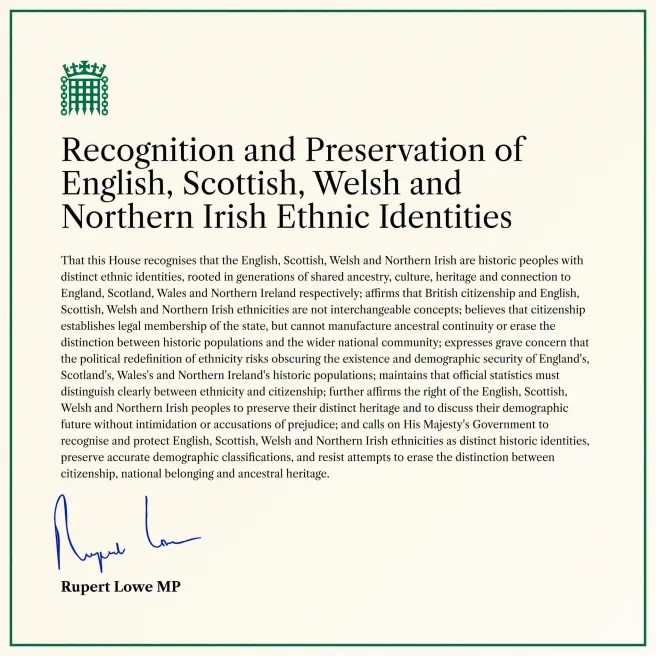
The prospect of the UK Parliament debating who is and who isn’t English on St George’s Day*, and what English identity means is a mouth-watering prospect. It should really be a debate for an English parliament. But we don’t have one. And this, perhaps, is why the English question is such a hot potato. England doesn’t exist in any meaningful political or constitutional sense, it is merely that part of the UK that lacks the usual trappings of nationhood, its national sports teams and politically contested flag aside. There is an insecurity about English identity because of this, and it is rare to hear UK MPs articulate any idea of England, or mention it at all.
Babarinde is correct to say that Englishness is a layered, multifaceted thing. The Census should reflect that. English Commonwealth welcomes Babarinde’s bill to remove the racial barrier to English ethnicity. You do not have to be white to be English.
* The second reading of the Ethnic English Identity Bill, dubbed ‘the St George’s Day Bill’, will be on St George’s Day 2027.


