In an interview with Sky News, Rishi Sunak has responded to Suella Braverman’s ethnonationalist views on English identity.
Despite being asked specifically about Englishness, Sunak responds to reframe the question as being about both England and Britain. He then spends the rest of the interview talking about ‘the country’. This highlights the problem England faces as a nation and why it’s difficult to take Sunak’s ‘robust view on the need for people to integrate’ seriously. If you can’t speak of England as a discrete nation, different from Britain rather than a synonym for Britain, then why on earth would immigrants adopt English identity?
This problem around England/Britain was highlighted in bizarre fashion by Sunak himself in 2020. The Financial Times published an interview with Sunak in which he stated that his parents migrated to Southampton, England. After publication, Sunak felt the need to take to social media to correct the record and make clear that it was the United Kingdom, not England, that stood for the values that attracted his parents.
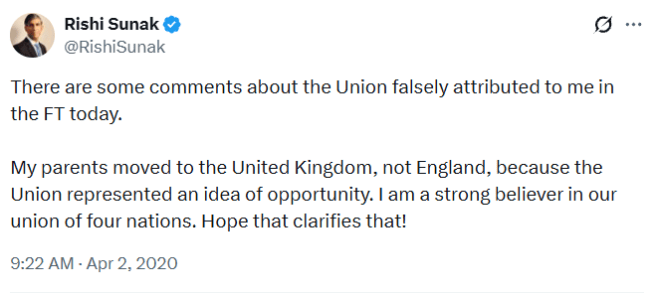
His parents literally moved to England. Yet, presumably, it was deemed not prime-ministerial to say so and could have been interpreted as implying indifference to the Union. You can visualise the scene in Downing Street as spads read the morning papers and all the colour drained from their faces as they realised that the PM had correctly said that his parents had moved to England.
“You can’t say England, Prime Minister”.
“Why not?”.
“Well, you know…It sends the wrong message, let’s get on Twitter and correct the record.”
“Do I have to?”
“Yes. Yes you do, and quickly.”
Sunak’s premiership – like that of all prime ministers – was marked by a lack of territorial clarity. Not wanting to assume the role of de facto First Minister of England, they choose instead to leave the England part unspoken, so even when talking about explicitly England-only policy it is framed as relevant to Britain or the enigmatic ‘the country’.
When power was devolved to Scotland, Wales and Northern Ireland, England was also redefined, but only negatively as that nation of the United Kingdom that did not have its own democracy, its own voice. There was no attempt to positively redefine England. The discussion at Westminster was centred on how the West Lothian Question upset the bipartisan balance and the Union, there was little to no discussion about what it meant for England as a nation and how England could define itself in the absence of a first minister, government and parliament, and with a British political class that prefers not to mention its name.
Westminster politicians have spent the years since devolution to Scotland, Wales and Northern Ireland defending the Union and speaking up for Britishness as the civic, inclusive, multicultural national identity. Politicians at Holyrood and Cardiff Bay have done the same for Scottish and Welsh national identities. But who speaks for England in the same manner? Shamefully, that fell to Gareth Southgate, the England football manager.
Suella Braverman and others who want England defined in purely ethnocentric terms are inhabiting an England-shaped negative space, vacated by a British political class uncomfortable talking about England and who deny England the democratic space and institutions to positively define itself.


